

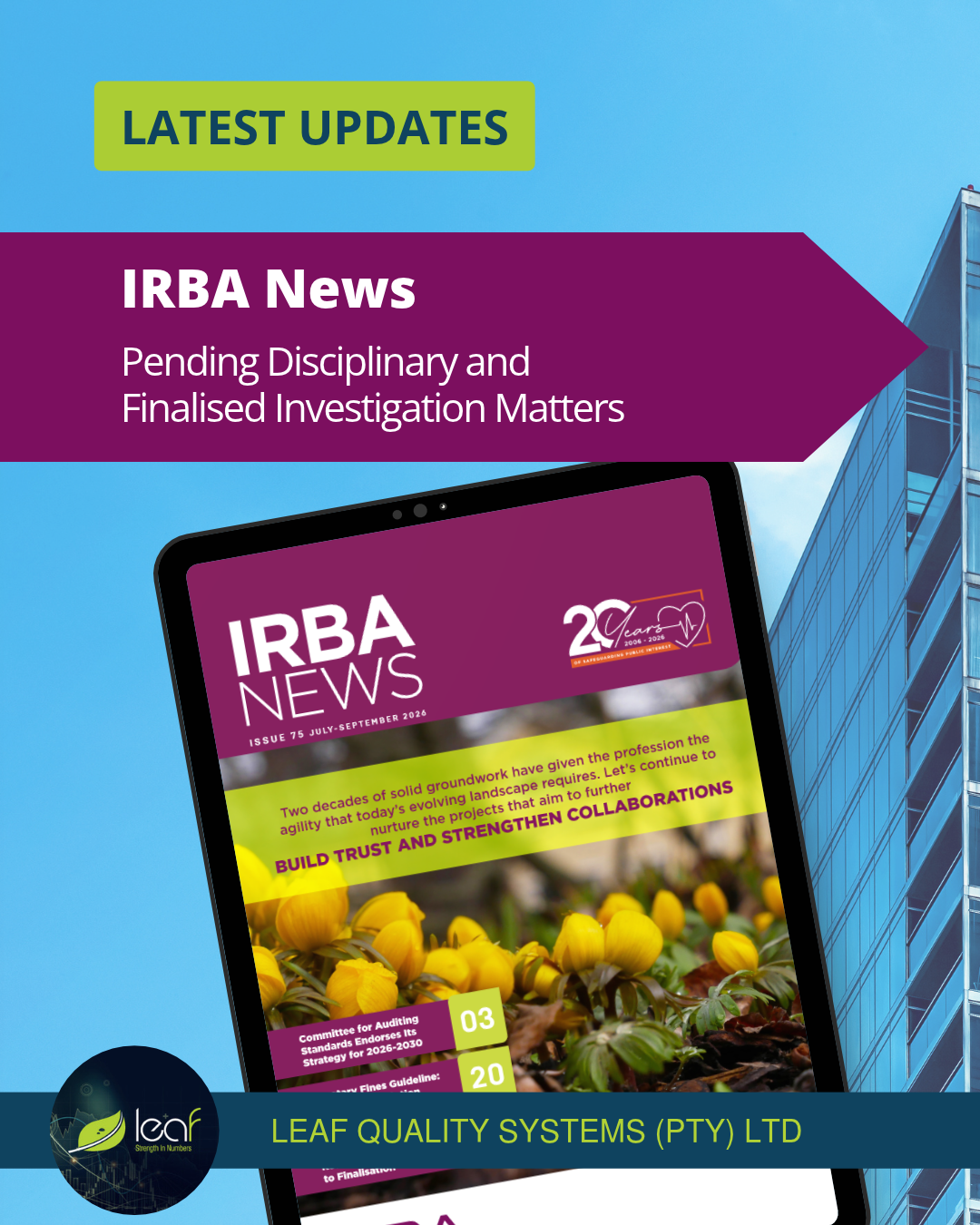
Pending Disciplinary and Finalised Investigation Matters
In Issue 75 of IRBA News, 10 disciplinary matters pending disciplinary hearings, two finalised disciplinary matters and 11 finalised investigation matters were reported.
Current open matters referred for disciplinary hearings involve 16 categories of improper conduct.
The most common charges are insufficient appropriate audit evidence, failure to exercise due care and skill, and non-declaration of assurance work. Other frequent charges include failure to document considerations or audit evidence, dishonesty and lack of integrity, failure to archive audit files, and incorrect or defective audit reports.
Non-compliance with quality standards, lack of professional scepticism, incorrect audit opinions, failure to report reportable irregularities, tax and accounting issues, independence issues, contravention of the Prevention and Combating of Corrupt Activities Act, executor or trustee duties and unprofessional conduct make up the remaining categories.
In several investigation matters, among others, independence threats were not identified, evaluated and responded to; adequate risk assessment procedures were not performed; and sufficient, appropriate audit evidence was not obtained for material balances and disclosures.
This issue may be accessed on:
Frequently asked questions
What did Issue 75 of IRBA News report?
It reported 10 disciplinary matters pending disciplinary hearings, two finalised disciplinary matters and 11 finalised investigation matters.
What are the most common charges against registered auditors in the open matters?
The most common charges are insufficient appropriate audit evidence, failure to exercise due care and skill, and non-declaration of assurance work.
Stay up to date with LEAF’s News Room, or subscribe to our newsletter using the sign-up on this page.
Latest Updates


What's News

New business challenges to small and medium practices (SMPs)
With increasing regulatory demands, many small and medium-sized audit practices (SMPs) have shifted their focus almost entirely to compliance — often at the expense of essential business practices. While ISQM 1 and ISQM 2 introduce some business-aligned principles, they are frequently applied in a narrow, compliance-driven manner, rather than being integrated into the firm’s broader operations.
To truly benefit, firms should approach these requirements by asking, ‘What is ...
Audit Issues & Trends to Consider

- Corroborating evidence for client discussions
Enquiry is an audit procedure used extensively throughout the audit, in addition to other audit procedures. Evaluating responses to enquiries is an important part of the enquiry process. Responses to enquiries may provide new information or corroborative audit evidence, or information that differs significantly from other information already obtained, for example, information regarding the possibility of management override of controls. In some cases, responses provide a basis for ...


