Committee for Auditing Standards Strategy 2026-2030
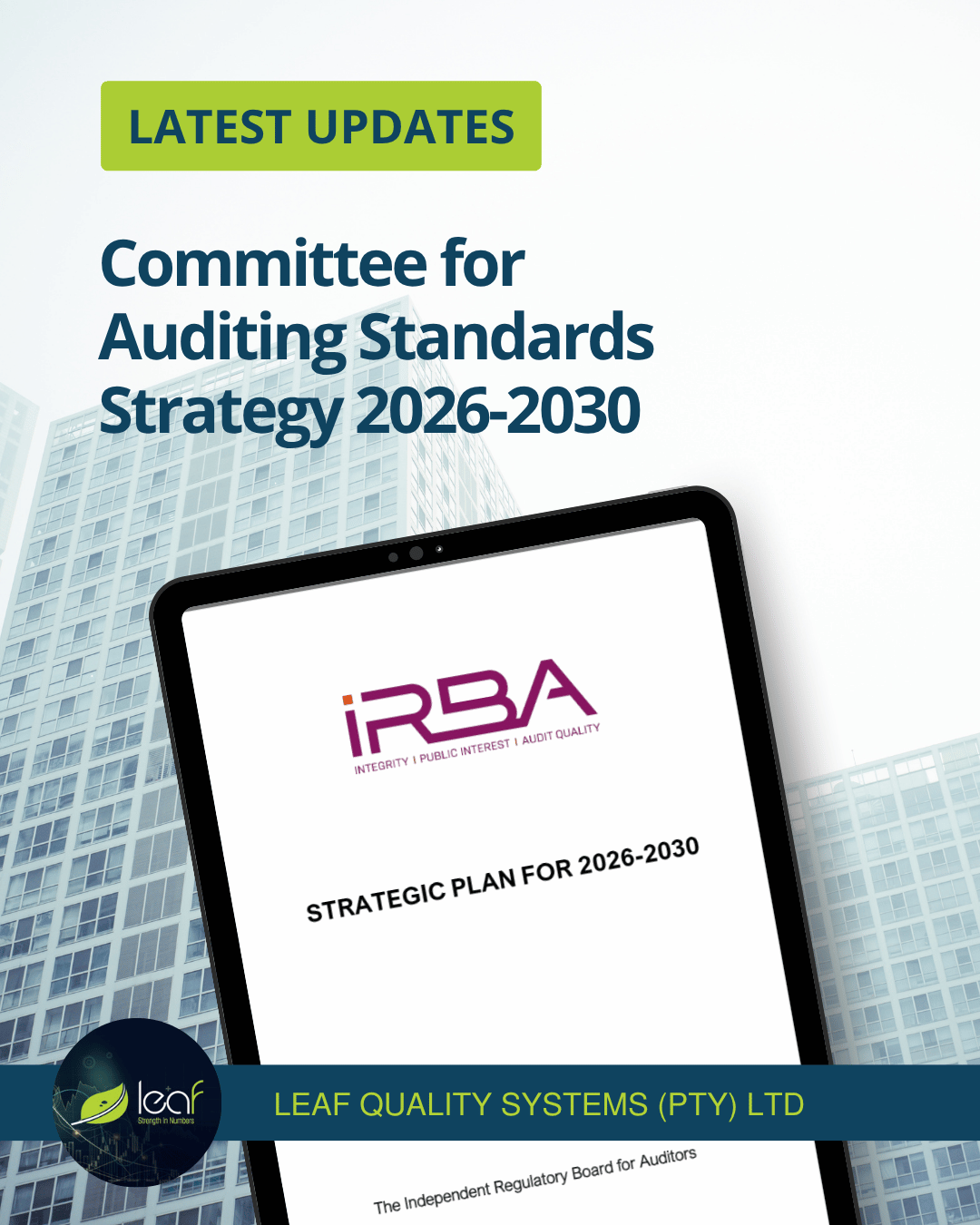
LEAF Quality Systems (Pty) Ltd2026-09-30T14:40:19+02:00IRBA's Committee for Auditing Standards approves its Strategy 2026-2030, Innovation and Collaboration for High-Quality Audits.
IRBA's Committee for Auditing Standards approves its Strategy 2026-2030, Innovation and Collaboration for High-Quality Audits.
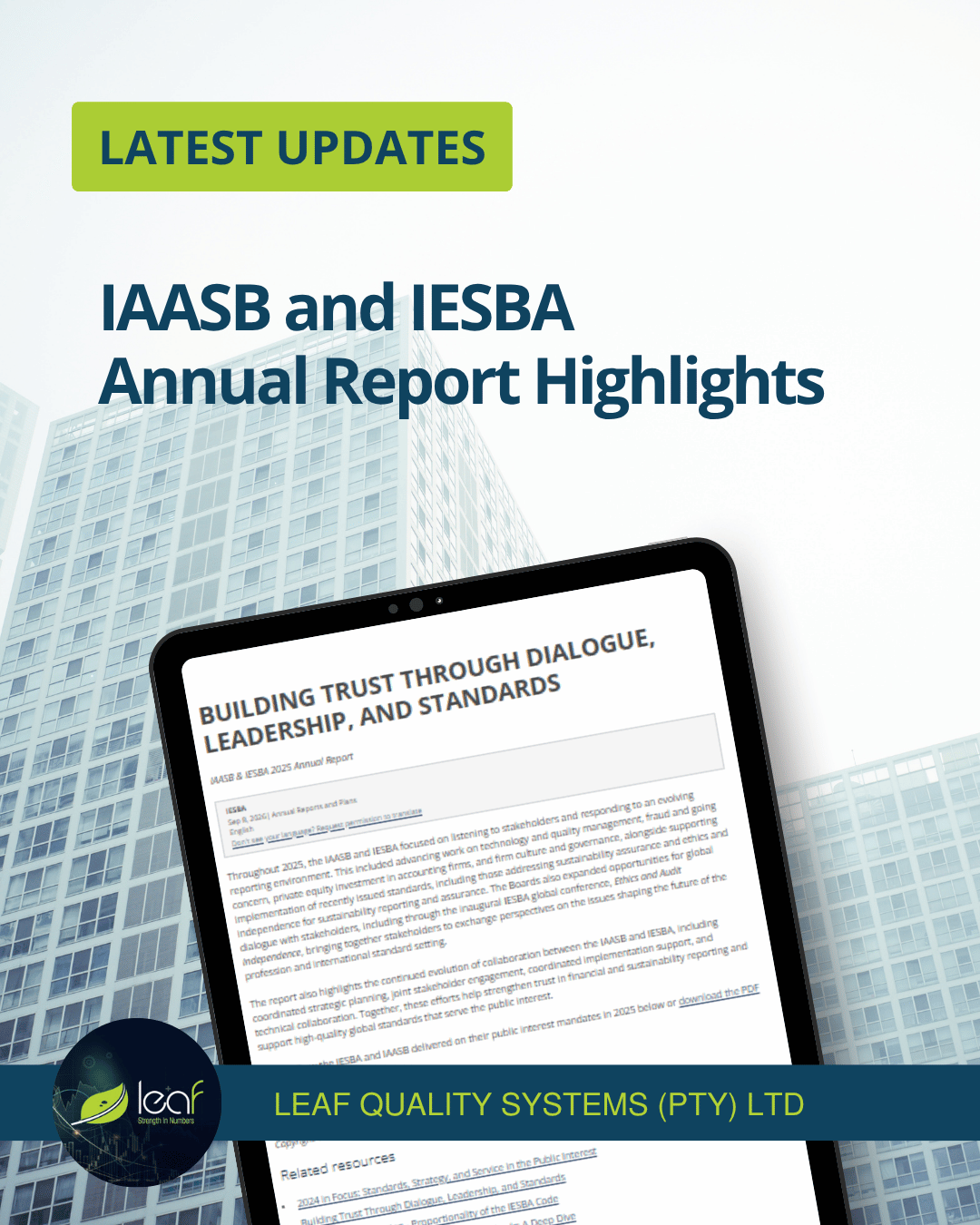
IAASB and IESBA release their 2025 Joint Annual Report, highlighting global stakeholder engagement and progress on international standards.
CIPC Notice 35 of 2026 clarifies transitional provisions for sections 30A and 30B of the amended Companies Act.
CIPC Notice 35 of 2026 clarifies transitional provisions for sections 30A and 30B of the amended Companies Act.
Back by popular demand. A practical ethics webinar for accounting and audit professionals. What You Will Learn The ground rules of professional ethics and their importance in audit quality The latest ethical pronouncements and developments How to identify, evaluate and address threats to compliance with ethical requirements The relationship between independence, ethics and professional scepticism How to apply ethical requirements to practical audit scenarios Appropriate documentation of ethical considerations and conclusions How to reflect on and strengthen your own ethical decision-making Content and outline: To explain the following concepts and demonstrate their practical application: [...]
Understanding the revised fraud standard and its impact on audit engagements Overview Although auditors are not forensic investigators, they have a fundamental responsibility to apply professional scepticism throughout every audit engagement. High-profile corporate failures across the globe have intensified public scrutiny of auditors' responsibilities relating to fraud, leading to increased expectations from regulators, investors, and other stakeholders. To address evolving fraud risks, changing public expectations, and increasingly complex business environments, the revised ISA 240 introduces enhanced requirements for identifying, assessing, and responding to fraud risks during an audit. This practical course provides participants with a [...]
Understanding the revised fraud standard and its impact on audit engagements Overview Although auditors are not forensic investigators, they have a fundamental responsibility to apply professional scepticism throughout every audit engagement. High-profile corporate failures across the globe have intensified public scrutiny of auditors' responsibilities relating to fraud, leading to increased expectations from regulators, investors, and other stakeholders. To address evolving fraud risks, changing public expectations, and increasingly complex business environments, the revised ISA 240 introduces enhanced requirements for identifying, assessing, and responding to fraud risks during an audit. This practical course provides participants with a [...]
Understanding Going Concern (Revised 2024) Overview The going concern concept is a fundamental accounting assumption that an entity will continue operating in the foreseeable future to fulfil its commitments, obligations and objectives, rather than being forced to liquidate or cease operations in the short term. ISA 570 (Revised 2024) strengthens the auditor’s responsibilities when evaluating management’s assessment of going concern. The revised standard was issued following high-profile corporate failures that raised concerns about audit effectiveness and the robustness of going concern evaluations. While IFRS does not change recognition and measurement under going concern, the auditor’s [...]
Understanding Going Concern (Revised 2024) Overview The going concern concept is a fundamental accounting assumption that an entity will continue operating in the foreseeable future to fulfil its commitments, obligations and objectives, rather than being forced to liquidate or cease operations in the short term. ISA 570 (Revised 2024) strengthens the auditor’s responsibilities when evaluating management’s assessment of going concern. The revised standard was issued following high-profile corporate failures that raised concerns about audit effectiveness and the robustness of going concern evaluations. While IFRS does not change recognition and measurement under going concern, the auditor’s [...]
What’s News? The Brain Drain of Audit Quality For decades, audit quality, in general, has failed to prevent audit failures. Upgraded audit standards, and stricter independence requirements have been implemented in an attempt to address the challenge. In my opinion, there are a number of environmental factors being overlooked in the formal structures that set audit standards and educational standards, causing a drain on knowledge and experience in the profession, (the so-called ‘brain drain’). I am listing a few: Computer skills In my opinion, the brain drain started when personal computers were introduced into audit. Many manual calculations, [...]