Clients’ Use of Service Organisations

2026-04-29T13:31:34+02:00

LATEST UPDATE Clients’ Use of Service Organisations In the latest issue of IRBA News, Issue 73, an article was published on insights and observations on auditing clients' use of service organisations in inspections. The article includes reflections on complexities in audits, where the use of service organisations directly impacts the audit of the user entity's financial statements; references to relevant audit requirements; and common inspections observations. The most common inspections observations include the failure by auditors to identify the use of service organisations, and identification of service organisations without obtaining sufficient audit evidence supporting the [...]

Clients’ Use of Service Organisations2026-04-29T13:31:34+02:00

Photographic Evidence

2026-04-01T10:31:09+02:00

When an auditor obtains photographic evidence to support audit procedures, the requirements for audit evidence need to be considered, i.e. Sufficient and appropriate Relevant and reliable Accurate and complete Sufficiently precise for purpose It should be kept in mind that evidence is persuasive, rather than conclusive. ISA 200 para 5: ‘As the basis for the auditor’s opinion, ISAs require the auditor to obtain reasonable assurance about whether the financial statements as a whole are free from material misstatement, whether due to fraud or error. Reasonable assurance is a high level of assurance. It is [...]

Photographic Evidence2026-04-01T10:31:09+02:00

Key Audit Issues and Emerging Trends in Financial Reporting Compliance

2026-03-31T16:37:47+02:00

Your Content Goes Here Verification of compliance with the financial reporting framework Auditors frequently make use of disclosure checklists to verify compliance with the requirements of the relevant financial reporting framework. When making use of such checklists, it is very important to document the auditor’s considerations in support of the ‘Yes’, ‘No’ or ‘N/A’ answers provided. If there is no or insufficient support documented, the audit work is not re-performable, which is non-compliant with ISA 230 and makes it very difficult to check whether conclusions documented are correct under the circumstances. Incorrect conclusions regarding compliance with the financial reporting [...]

Key Audit Issues and Emerging Trends in Financial Reporting Compliance2026-03-31T16:37:47+02:00

IRBA Adopts the International Standard on Auditing 240 (Revised)

2025-12-09T14:22:33+02:00

LATEST UPDATE IRBA Adopts the International Standard on Auditing 240 (Revised) The Independent Regulatory Board for Auditors (IRBA) announced the adoption, issue and prescription of the International Standard on Auditing (ISA) 240 (Revised), The Auditor’s Responsibilities Relating to Fraud in an Audit of Financial Statements (ISA 240 (Revised)), for use by registered auditors in South Africa. This follows the International Auditing and Assurance Standards Board’s (IAASB) release of ISA 240 (Revised) in July 2025. Recent high-profile corporate failures have intensified the public scrutiny of auditors’ responsibilities relating to fraud. As a result, the IAASB undertook [...]

IRBA Adopts the International Standard on Auditing 240 (Revised)2025-12-09T14:22:33+02:00

IASB Issues Illustrative Examples on Reporting Uncertainties in Financial Statements

2025-12-09T13:32:29+02:00

LATEST UPDATE IASB Issues Illustrative Examples on Reporting Uncertainties in Financial Statements The International Accounting Standards Board (IASB) has issued illustrative examples demonstrating how companies may apply IFRS Accounting Standards when reporting the effects of uncertainties in their financial statements. The examples use climate-related scenarios as practical illustrations, but the underlying principles apply more broadly to all uncertainties. According to stakeholders, the information companies provide about the effects of uncertainties is sometimes insufficient, or appears inconsistent with the information provided outside their financial statements. To help address this, the IASB developed these illustrative examples to [...]

IASB Issues Illustrative Examples on Reporting Uncertainties in Financial Statements2025-12-09T13:32:29+02:00

IRBA Annual Report 2025 Tabled in Parliament: A Milestone Year

2025-11-28T13:47:36+02:00

LATEST UPDATE IRBA Annual Report 2025 Tabled in Parliament: A Milestone Year The Independent Regulatory Board for Auditors (IRBA) has officially tabled its Annual Report for the 2024/2025 financial year before the Standing Committee of Finance in Parliament, marking the conclusion of its five-year strategic cycle. The Annual Report reflects a year of significant progress in restoring trust with key stakeholders, enhancing oversight effectiveness, and fostering transparency within the profession. Key highlights include: Strategic Transition Audit Quality Improvements Transformation and Talent Development Regulatory Advancements Stakeholder Engagement. The IRBA also received a clean audit opinion from [...]

IRBA Annual Report 2025 Tabled in Parliament: A Milestone Year2025-11-28T13:47:36+02:00

IASB Issues Amendments for Translating Financial Information into Hyperinflationary Currencies

2025-11-28T13:40:52+02:00

LATEST UPDATE IASB Issues Amendments for Translating Financial Information into Hyperinflationary Currencies The International Accounting Standards Board (IASB) has issued amendments to clarify how companies should translate financial statements from a non-hyperinflationary currency into a hyperinflationary one. These narrow-scope amendments aim to improve the usefulness of the resulting information in a cost-effective manner. Developed in response to stakeholder feedback, these amendments are expected to reduce diversity in practice and provide a clearer basis for reporting in a hyperinflationary currency. The amendments to IAS 21 The Effects of Changes in Foreign Exchange Rates are effective for [...]

IASB Issues Amendments for Translating Financial Information into Hyperinflationary Currencies2025-11-28T13:40:52+02:00

Educational Modules on the Third Edition of IFRS for SMEs Published

2025-11-28T13:42:52+02:00

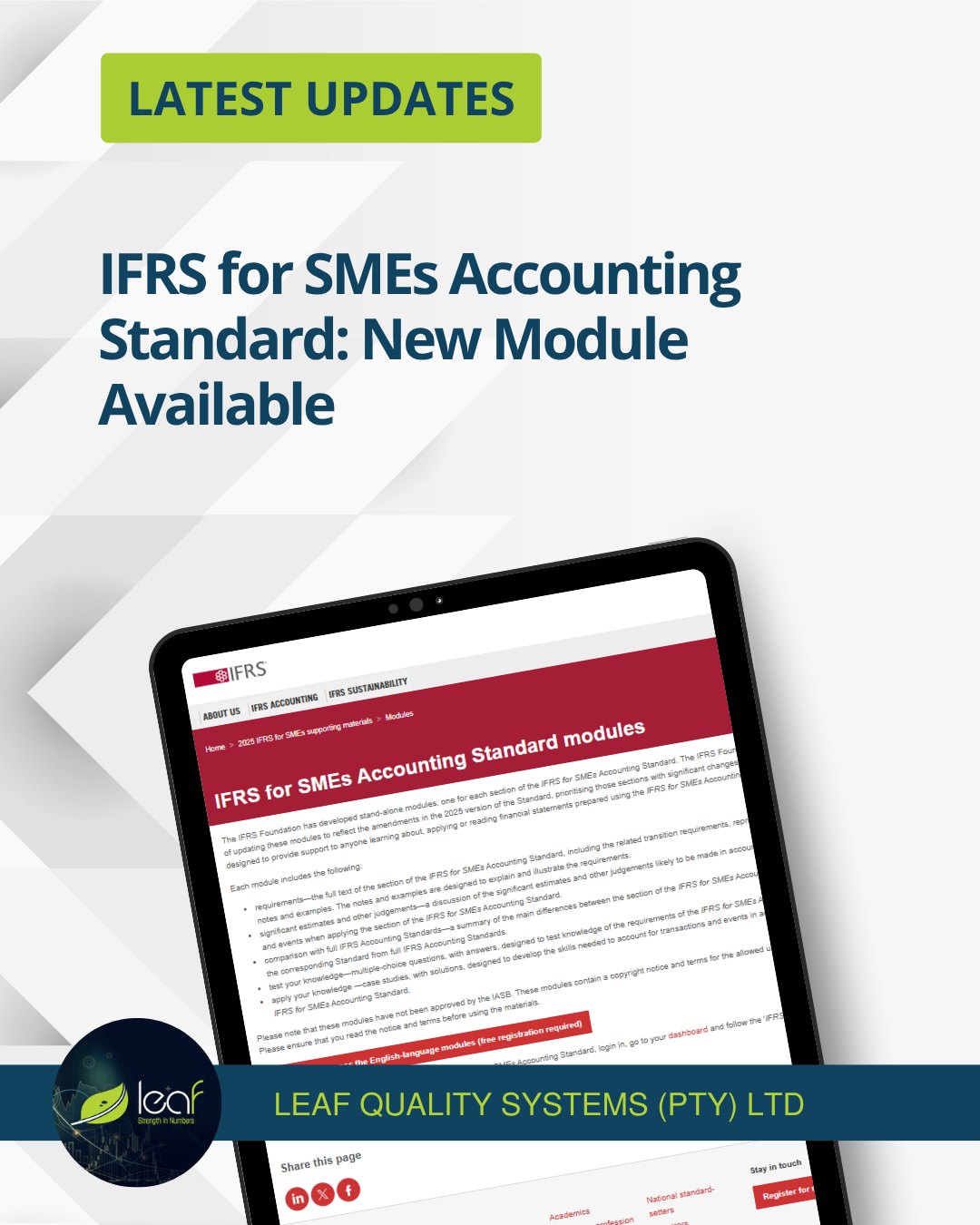
LATEST UPDATE Educational Modules on the Third Edition of IFRS for SMEs Published The IFRS Foundation has published a package of new educational resources to support implementation of the third edition of the IFRS for SMEs Accounting Standard. These materials are aimed at stakeholders learning about or applying the IFRS for SMEs Accounting Standard. New educational modules: Module 12 Fair Value Measurement Module 9 Consolidated and Separate Financial Statements. Each module provides practical support and includes a comparison to the related full IFRS Accounting Standard. The educational models are available on: https://www.ifrs.org/supporting-implementation/2025-ifrs-for-smes-supporting-materials/modules/ more [...]

Educational Modules on the Third Edition of IFRS for SMEs Published2025-11-28T13:42:52+02:00

New Educational Materials Available to Support Implementation of the IFRS for SMEs Accounting Standard

2025-11-26T12:25:02+02:00

LATEST UPDATE New Educational Materials Available to Support Implementation of the IFRS for SMEs Accounting Standard The IFRS Foundation has published a package of new educational resources to support implementation of the third edition of the IFRS for SMEs Accounting Standard. These materials are aimed at stakeholders learning about, or applying the IFRS for SMEs Accounting Standard. New educational modules: Module 19 Business Combinations and Goodwill Module 35 Transition to the IFRS for SMEs Standard Each module provides practical support and includes a comparison with the related full IFRS Accounting Standard. The education models are [...]

New Educational Materials Available to Support Implementation of the IFRS for SMEs Accounting Standard2025-11-26T12:25:02+02:00

Release of Staff Audit Practice Alert 11: The Use of Generative Artificial Intelligence and Emerging Technologies in Audits

2025-11-26T12:16:30+02:00

LATEST UPDATE Release of Staff Audit Practice Alert 11: The Use of Generative Artificial Intelligence and Emerging Technologies in Audits The Independent Regulatory Board for Auditors (IRBA) has issued Staff Audit Practice Alert 11: The Use of Generative Artificial Intelligence and Emerging Technologies in Audits. This non-authoritative guidance provides insights into the impact of generative artificial intelligence (GenAI) and emerging technologies when applying certain requirements of the International Standards on Quality Management and the International Standards on Auditing in the South African context. As the profession continues to evolve in response to technological advancements, it [...]

Release of Staff Audit Practice Alert 11: The Use of Generative Artificial Intelligence and Emerging Technologies in Audits2025-11-26T12:16:30+02:00
Go to Top